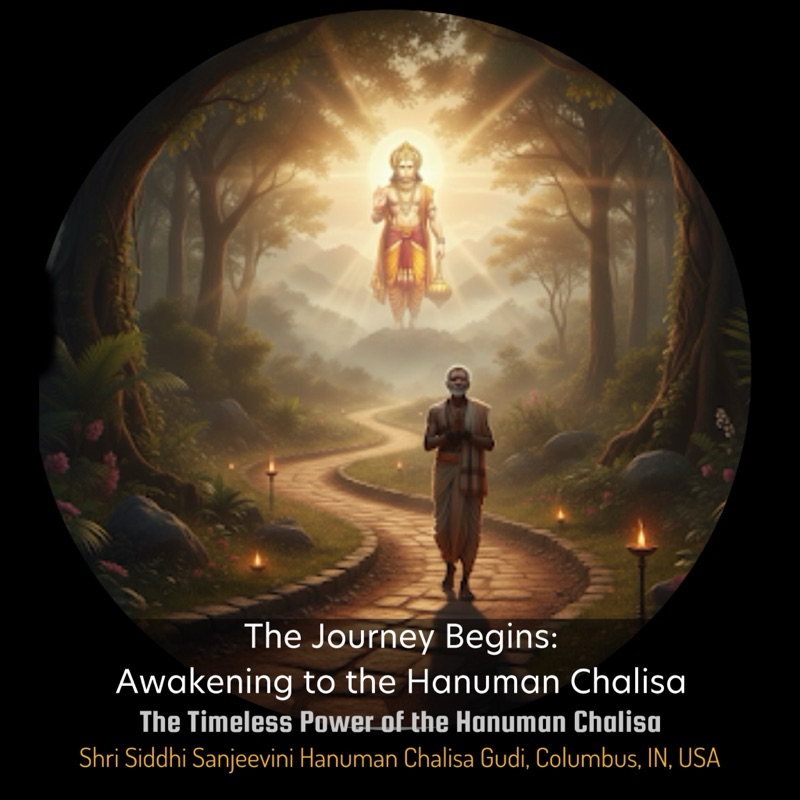
5. The Journey Begins: Awakening to the Hanuman Chalisa
~ Tue, Sep 30, 2025
Setting the Context
Now that we have laid the foundation, let us take the next step—understanding how to read, feel, and interpret the dohas and chaupais of the Hanuman Chalisa. Before we enter into the explanations, it is important to share the background of how this journey began and how we arrived here.
The Beginning of the Journey
It was in January 2025 when I was blessed with repeated visions of Neem Karoli Baba in my dreams. In those dreams, a task was entrusted to me: to take a deep dive into the Hanuman Chalisa and spread its message.
At that time, I did not even know who Baba was. I might have remembered if his name had been mentioned in the dream, especially with the connection to Steve Jobs meeting him. But the towering figure who keeps appearing in my dreams—I just can’t identify who he is based solely on his appearance.
By divine arrangement, I stumbled upon his life story on YouTube, and soon after, a dear friend gifted me a beautiful book "Be Here Now” by Ram Dass, a long time devotee of Baba. From there, my path unfolded—I immersed myself in reading, listening, and exploring everything I could find on the Hanuman Chalisa.
Although I had been chanting the Chalisa before, my practice lacked a systematic approach. This inquisitive journey led me to:
- Explore hundreds of videos/vlogs by great devotees of Hanuman.
- Read multiple books on the Chalisa.
- Listen to devotees’ personal experiences of transformation through chanting.
Through collective practice, Hanuman’s intuitive guidance, and shared feedback, two unique parayana (recital) methods eventually emerged:
1. Chalisa Nitya Siddhi Parayana
A daily chanting process that makes the Hanuman Chalisa a natural part of one’s routine. This immersion in devotion creates blessings, grants unexpected siddhis (fulfilled wishes), and offers divine protection to the devotee.
2. Chalisa Siddhi Sankalpa Parayana
A special practice performed only with the divine permission of Hanuman, who reveals the number of Saturdays one must chant the Chalisa for a specific intention (Sankalpa). Through this, devotees invoke His special grace either for the fulfillment of heartfelt wishes or to overcome grave challenges.
To our joy, devotees across the globe soon started connecting and began experiencing the benefits of this approach. What started as a small circle is slowly growing into a Hanuman network—a living, breathing community of seekers, united by devotion, sharing experiences, and spreading the light of the Chalisa.
The Real Secret of the Chalisa: Chalisa Siddhi Sanjeevini Parayana
In my journey, I realized that the true way to receive Hanuman’s blessings and to unlock the immense power of the Chalisa is not just in chanting the verses, but in understanding their meaning and invoking the right emotions while reciting every doha and chaupai. This realization opened the doorway to the third and advanced method — Chalisa Siddhi Sanjeevini Parayana — where the heart, mind, and soul come together in deep immersion while chanting.
When the Chalisa is chanted in this way — with deep meaning and heartfelt emotion — something profound begins to happen. The veil between the Devotee and the Devine slowly drops, and a living connection with Hanuman is awakened at the very core of one’s being. Tears may flow during chanting, His presence becomes tangible, and Hanuman Himself begins to take personal care of the devotee, guiding, protecting, and carrying them forward on the sacred path. Jai Shree Ram! Jai Hanuman!!
The Purpose of This Work
While many existing books on the Hanuman Chalisa are valuable, most either take long detours into Hanuman’s stories or confine themselves to simple word-by-word translations. The purpose of this work is different.
Its aim is:
- To provide clear and devotional explanations of every doha and chaupai.
- To guide the emotions that should be invoked while chanting.
- To offer a living, heart-centered approach that makes the Chalisa come alive in spirit.
How This Book is Structured
In the following sections,
- Every verse of the Chalisa is explained in depth to reveal its deeper meaning. To help the reader connect more fully, each explanation includes:
- Highlighted text (in red): showing the emotions to invoke during chanting.
- Verse type: whether it is praise of Hanuman, an invocation, a phalashruti (fruit or outcome), or a closing verse.
- Hanuman’s qualities (gunas): especially those embodied in the Shree Siddhi Sanjeevini Hanuman idol, where 11 divine attributes shine forth.
Gratitude and Reverence
I bow with reverence and gratitude to:
- To Hanuman ji, who revealed Himself in the form of Shree Siddhi Sanjeevini Hanuman — the One who bestows prosperity at every level (Shree), grants wishes (Siddhi), and removes obstacles with healing grace (Sanjeevini). It is by His will that I have been entrusted with this sacred work of diving deep into the Chalisa and spreading its message.
- To Goswami Tulsidas ji, whose timeless masterpiece has illuminated hearts and uplifted souls for centuries.
- To Neem Karoli Baba, who set me upon this divine path.
- To Sai Baba of Shirdi, whose blessings and grace have accompanied me at every step.
- To Adi Parashakti Devi, who guides, nurtures, and sustains this journey.
- To Tejas, my spiritual mentor, whose tireless dedication and countless hours of loving guidance have been the light on this path.
Daily Recital and Integration
The final chapter is dedicated entirely to a daily recital guide—just the Chalisa verses with the corresponding emotions to invoke.
By practicing this method of chanting for a few days, it will gradually become natural and spontaneous—until the Chalisa no longer feels like something you recite, but rather something that flows through you, as one with your being.
Jai Shree Ram! Jai Hanumaan!!
Shri Siddhi Sanjeevini Hanuman Chalisa Gudi, Columbus, IN, USA


Comments
Post a Comment