Unlocking Doha 1
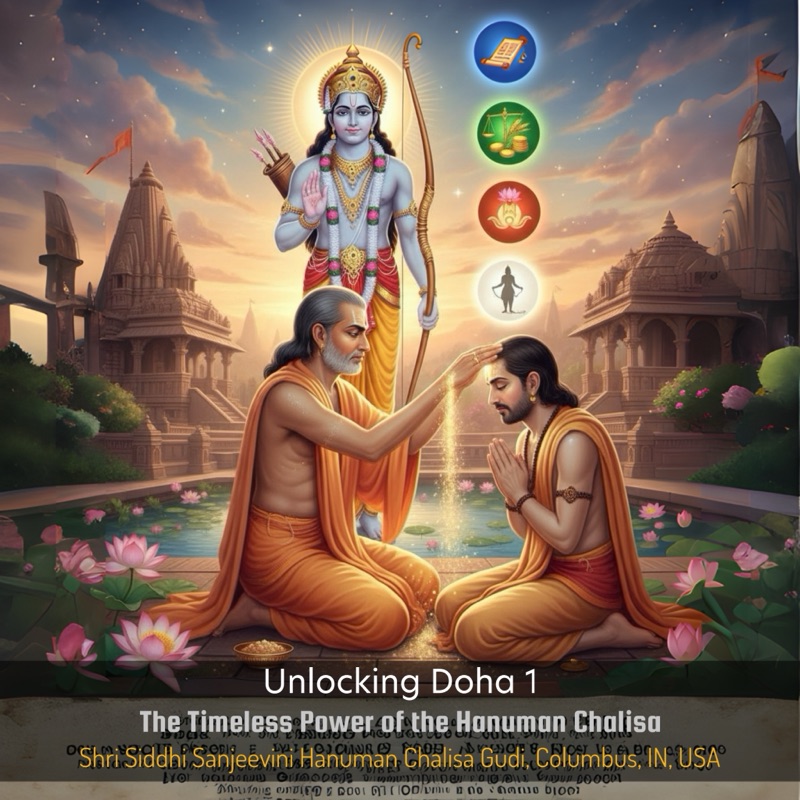
~ Sat, Oct 4, 2025
Shri Ganeshaya Namah
(Salutations to Lord Ganesha, remover of obstacles)
What divine emotion should one invoke?: Before beginning the Hanuman Chalisa, invoke Lord Ganesha with Śhrī Gaṇeśāya Namaḥ — salutations to the remover of obstacles. By seeking Ganesha’s blessings first, the path of devotion becomes clear and free from hindrances.
Next, invoke Devi and Guru — their deeper purpose will soon be revealed.
Then, prepare your mind to invoke Hanuman’s blessings through the chanting of the Chalisa, and to receive the siddhis that flow from devoted repetition
Doha 1
श्रीगुरु चरन सरोज रज, निज मनु मुकुरु सुधारि।
बरनउँ रघुबर बिमल जसु, जो दायकु फल चारि॥
Shrī guru charan saroja raj, nija manu mukuru sudhāri,
Baranau Raghubar bimal jasu, jo dāyaku phala chāri.
I cleanse the mirror of my mind with the dust of my Guru’s feet, and sing the pure glory of Lord Rama, which bestows the four fruits of life — Dharma, Artha, Kama, and Moksha.
श्रीगुरु चरन सरोज रज (shrī guru charan saroja raj)
निज मनु मुकुरु सुधारि (nija manu mukuru sudhāri)
- श्री (Shrī) – auspicious, revered, divine, shakti.
- गुरु (Guru) – teacher, spiritual master.
- चरन (Charan) – feet (symbol of humility, surrender, foundation).
- सरोज (Saroja) – lotus (pure, untouched by worldly impurities).
- रज (Raj) – dust, particles (symbol of deep reverence, humility)
- निज (Nija) – my own, personal.
- मनु (Manu) – mind, heart, inner instrument.
- मुकुरु (Mukuru) – mirror, the reflective consciousness.
- सुधारि (Sudhāri) – cleanse, polish, purify.
👉 “With the dust of the lotus-feet of the revered Guru, I polish the mirror of my own mind...”
- श्री (Shrī)
- The very first word “Śhrī” calls upon Devi / Sita Ma / Lakshmi.
- She is Shakti, the sustaining force. By remembering her at the outset of the Hanuman Chalisa, the devotee seeks her blessings to maintain and stabilize the power (siddhis) that arise from devotion to Hanuman.
- Just as Rama is complete only with Sita, the devotee too becomes complete only when Shakti is invoked alongside Bhakti.
What divine emotion should one invoke?:
“After invoking Lord Ganesha to remove obstacles, the word ‘Śhrī’ calls upon Devi — Shakti, whose blessings sustain and stabilize the siddhis gained through repeated devoted chanting of the Chalisa.”
श्री गुरु (Shrī Guru)
- Not merely a worldly Guru (teacher), but Śhrī Guru, Sadguru — the Divine Guru, the eternal guiding force who dispels darkness (Gu = darkness, Ru = remover).
- This may be the Guru of your lineage (for Tulsidas, Narharidas), or any revered master — Sai Baba, Raghavendra Swami, Akkalkot Maharaj, Basavanna, or another saint who connects you to the Divine.
- Your Guru can also be Hanuman Himself, the supreme teacher of devotion, courage, wisdom, and surrender.
- Even if no outer Guru is present, one can invoke the inner Guru-tattva — the eternal principle of Divine wisdom within.
- Thus, “Śhrī Guru” is both personal and universal: Devi’s Shakti supporting you, the Guru’s blessings guiding you, and Hanuman himself as the living embodiment of Guru-tattva.
What divine emotion should one invoke?:
Invoke your Sadguru with the emotion of surrender, seeking blessings and guidance — for we do not wish to wander in confusion, but long for the Guru to hold our hand and lead us on the right path.
Note: Since it may not be possible to express all these emotions within a single line of the Doha, the invocations to Devi and Guru are offered right after invoking Lord Ganesha.
चरन सरोज रज (Charan Saroja Raj) - Guru’s Lotus Feet Dust
- Dust here doesn’t mean something insignificant. In the bhakti tradition, the dust of the Guru’s feet symbolizes humility, surrender, and grace. Just as dust settles low, a disciple lowers the ego before the Guru to receive wisdom.
- The lotus represents purity – untouched by mud though it grows in it.
- The Guru’s feet are considered like a lotus: beautiful, pure, and giving refuge.
- निज मनु मुकुरु सुधारि (nija manu mukuru sudhāri) - I cleanse the mirror of my mind
- Mirror of the Mind – The mind is compared to a mirror. When covered in dust (ignorance, ego, desires), it cannot reflect greace of Hanuman.
- By invoking the Guru’s blessings (dust of his feet), one should polishing his/her inner mirror. A polished mirror reflects reality as it is – the purified mind reflects Hanuman's grace thereby Rama’s glory without distortion.
What divine emotion should one invoke?
"Now imagine yourself bowing down at your Guru’s lotus feet, gently placing the golden dust upon your head in full submission, seeking his help and guidance. This sacred act cleanses the manas (mind) and prepares you to receive the grace of Hanuman through the Chalisa.”
बरनउँ रघुबर बिमल जसु sing the pure glory of Lord Rama
जो दायकु फल चारि which bestows the four fruits of life
- बरनउँ (Baranau) – I describe, narrate, sing.
- रघुबर (Raghubar) – Lord Rama, the noblest of the Raghu lineage.
- बिमल (Bimal) – pure, stainless, flawless.
- जसु (Jasu) – glory, fame, divine virtues.
- जो (Jo) – which.
- दायकु (Dāyaku) – giver, bestower.
- फल (Phal) – fruits, results.
- चारि (Chāri) – four, the four Purusharthas: Dharma, Artha, Kama, Moksha.
👉 “…I sing the spotless, pure glory of Lord Rama (Raghubar), which bestows the four fruits of human life”
- बरनउँ रघुबर बिमल जसु (sing the pure glory of Lord Rama)
Once the mind is cleansed, the poet says: "Now I sing of Raghuvar’s (Shri Rama’s) spotless glory."
- Bimal Jasu – Rama’s glory is stainless, pure, beyond worldly blemishes. Only a purified heart can perceive and describe it.
- Baranau (I narrate/express) also indicates humility – Tulsidas doesn’t claim authorship, but merely becomes an instrument to express divine glory.
- Now here comes a beautiful twist. One might think, since we are reciting the Hanuman Chalisa, the direct prayer should be to Hanuman himself. Yet Tulsidas chooses to invoke Shri Rama instead of Hanuman in the opening verse. There is an old story connected to this. While its authenticity cannot be fully confirmed, it is said that originally the line read ‘Baranau Hanumata’ — invoking Hanuman. But the Chalisa remained like a dry scripture, with no living grace flowing. When Tulsidas changed it to ‘Raghubara’ (Shri Rama), Hanuman was delighted, thinking: ‘Now devotees will sing the glory of my Lord Rama, so I will be present to bless them.’ And so, in praising Rama, we draw Hanuman himself — and in the verses that follow, our hearts naturally turn to glorifying Hanuman to seek his blessings.
- जो दायकु फल चारि (which bestows the four fruits of human life)
Now, what is the direct benefit of invoking Rama at the very beginning? It is that Rama’s name and glory naturally bestow the fourfold fulfillment of human life — the Purusharthas. These are:
- Artha – material prosperity, gained in harmony with dharma, not through greed.
- Kama – the fulfillment of rightful desires, aligned with virtue.
- Dharma – righteousness, living in tune with truth and duty.
- Moksha – liberation, the highest goal, transcending all worldly pursuits.
By invoking Rama, the Chalisa plants these four fruits at the heart of our sādhanā — and in time, it brings not only these but countless other blessings.
What divine emotion should one invoke?
"Now, with a heart full of reverence, praise Shri Rama along with his divine parivār, and seek their blessings. Feel that in doing so, you instantly receive the fourfold fulfillment of human life."
- Type of Verse: Invocation
- Guna: None


Comments
Post a Comment