Unlocking Chaupai 1
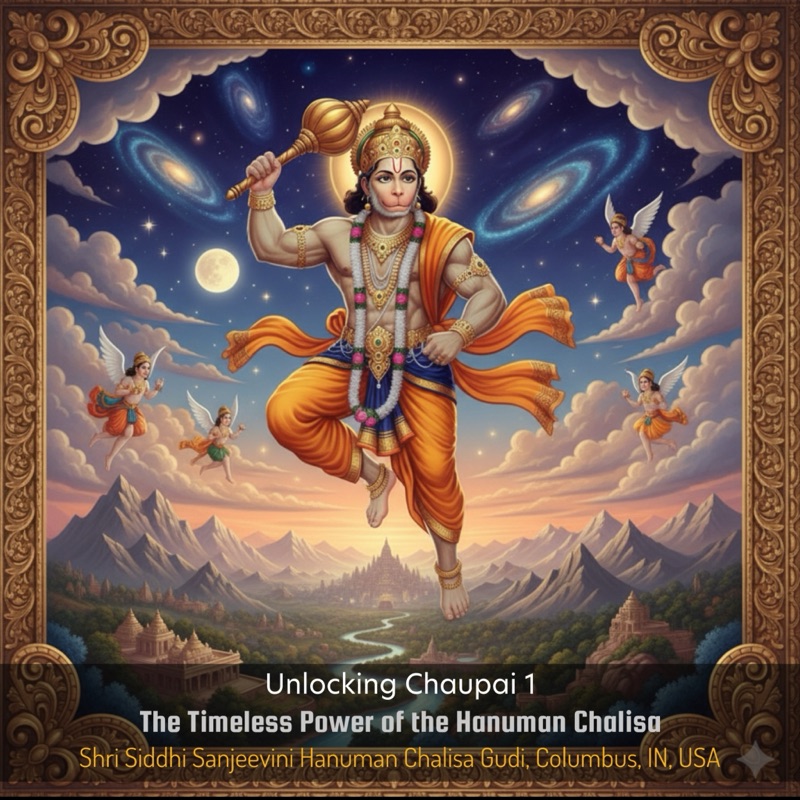
~ Sat, Oct 11, 2025
जय हनुमान ज्ञान गुण सागर ।
जय कपीस तिहुँ लोक उजागर ॥
Jaya Hanumān jñāna guṇa sāgara,
Jaya kapīsa tihũ loka ujāgara.
Victory to Hanuman, the ocean of wisdom and virtue.
Victory to the Lord of the monkeys, who illuminates the three worlds.
Word-by-word meaning
- जय (jaya) — victory, glory, salutations; a joyful cry of praise.
- हनुमान (hanumān) — Hanuman
- ज्ञान (jñāna) — true knowledge, not just intellect but spiritual realization, the awareness of the Self.
- गुण (guṇa) — divine qualities, virtues such as devotion, courage, compassion, humility, and purity.
- सागर (sāgara) — ocean, symbol of infinite depth and boundless vastness.
- जय (jaya) — again, victory or glory.
- कपीस (kapīsa) — kapi means monkey (symbol of restless mind), and īśa means lord — hence “Lord of the Vanaras,” the master of the mind.
- तिहुँ (tihũ) — three, referring to the three worlds (heaven, earth, and underworld).
- लोक (loka) — realms or planes of existence.
- उजागर (ujāgara) — illuminator, one who brings light, glory, and awareness everywhere.
1. जय हनुमान ज्ञान गुण सागर (Jaya Hanumān jñāna guṇa sāgara)
“Victory to Hanuman, the ocean of wisdom and virtue.”
- "Jaya Hanuman": This is not merely a greeting — it’s an invocation of Hanuman’s essence.
- "Jnana Guna Sagara: Hanuman represents jñāna (divine wisdom) and guṇa (divine virtues) in perfect balance. He is called an ocean because his knowledge and qualities are boundless, unfathomable, and ever-giving.
His jñāna is not book-knowledge; it is the inner realization that Rama (the Divine) dwells within all beings. His guṇas are the radiant expressions of that realization — humility, unwavering faith, fearless strength, compassion, and total self-surrender.
When you chant this line, you are not only praising Hanuman; you are invoking those same qualities within yourself — the potential to awaken your inner strength, purity, and wisdom.
What divine emotion should one invoke?:
"Praise Hanuman with an open heart, honoring Him as the boundless ocean of divine wisdom and noble virtues."
2. जय कपीस तिहुँ लोक उजागर (Jaya kapīsa tihũ loka ujāgara)
“Victory to the Lord of the Vanaras, who illumines the three worlds.”
"Kapīsa": Lord of the Vanaras — means the one who has mastery over the monkey nature of the minds
The mind jumps from thought to thought, restless and distracted like a monkey.
Hanuman, as Kapīsa, symbolizes the one who has tamed that restlessness and turned it into devotion and service.
By doing so, He becomes tihũ loka ujāgara — the light that shines across all three realms:
- In Heaven (Devaloka): He is revered by the gods as the perfect devotee.
- In the Mortal world (Mrityuloka): He uplifts human beings through His grace and example.
- In the Netherworld (Pātāla): He destroys darkness and ignorance.
Spiritually, these three worlds also exist within you:
- Heaven represents your higher consciousness,
- Earth your active, worldly life,
- Underworld your subconscious or darker tendencies.
Hanuman’s light (ujāgara) illumines all three — purifying every layer of your being.
What divine emotion should one invoke?:
“Hey Lord of my mind, illuminate my three inner worlds — my thoughts, my heart, and my hidden depths — with your divine light.
- Type of Verse: Praise of Hanuman
- Guna: Jnana (Knowledge), Guna (Virtue)
These qualities are beautifully depicted in the prabhāvali of the Shree Siddhi Sanjeevini Hanuman idol: the swan symbolizes divine knowledge, while the lotus represents noble virtues (guṇas).
Jai Shree Ram! Jai Hanumaan!!
Compiled by - bharath balemane
Shri Siddhi Sanjeevini Hanuman Chalisa Gudi, Columbus, IN, USA
Further Reading!
- What is the meaning of the word Hanuman?
The name Hanuman comes from two Sanskrit parts:
“Hanu” — meaning jaw or chin,
“Man” — meaning prominent, disfigured, broken
So Hanuman literally means “the one with the prominent or broken chin.”
Story Behind the Name:
As a child, Hanuman saw the rising sun and mistook it for a ripe fruit. With his divine power, he flew up and tried to swallow it. The world was plunged into darkness. To restore balance, Lord Indra struck the child with his thunderbolt. The blow hit Hanuman’s chin (hanu), wounding it deeply and causing him to fall unconscious.
The Wind God, his father, enraged at his son’s pain, withdrew all air from the universe, choking life everywhere. The gods, terrified, begged forgiveness and blessed the child with immense strength, wisdom, and divine powers.
Thus, the boy with the wounded chin became known as Hanuman — “He whose jaw (hanu) was struck, yet who rose invincible (man).”
The chin traditionally symbolizes pride, as people often lift their chin to show confidence or arrogance. Hanuman’s struck chin represents a divine lesson — a reminder that true greatness is not in showing off strength, knowledge, or virtues, but in humility. Hanuman embodies this perfectly: despite his limitless wisdom, immense strength, and boundless virtues, he never takes pride in them. His greatness lies in serving selflessly and remaining humble, showing that real power is inseparable from humility.
Essence:
The name “Hanuman” reminds us of his indestructible spirit — struck by the thunderbolt, yet rising with greater strength and divine grace.
2. Why is Hanuman called “Jñāna Guṇa Sāgara,” the ocean of knowledge and virtue?
Hanuman is called “Jñāna Guṇa Sāgara” — the ocean of knowledge and virtue — because He perfectly embodies both divine wisdom and noble character. He is the best among the learned (buddhimatām varistham), mastering all forms of knowledge from the Sun God, including 9 branches of grammer (Nava Yvakarana Pandita), which is very rare to achieve and realizing even the highest truth — Self-knowledge. Yet, despite His vast wisdom and unmatched strength, He remains the picture of humility, purity, and selfless service.
When Lord Rama asked, “Who are you?” Hanuman replied:
“As the body, I am Your servant;
as the soul, I am a part of You;
as the Self, I am one with You.”
This shows that His knowledge was not intellectual pride but spiritual realization.
The balance of these two — supreme knowledge and supreme virtue — is what makes Hanuman truly great.
He uses wisdom without arrogance, power without ego, and strength only in service of righteousness and love.
3. Why is Hanuman called Kapīśa?
Hanuman is called Kapīśa, meaning “Lord of the Monkeys”, not because he ruled a kingdom, but because of his spiritual mastery, courage, and leadership over the Vanaras. While Vali initially and then Sugriva were political kings of the monkeys, Hanuman was the true kingmaker — it was his bravery, wisdom, and strength that guided Sugriva and gave him power (Valmiki Ramayana, Yuddha Kanda, Ch. 36).
The title Kapīśa symbolizes a higher form of lordship:
- Not ruling over land or by popular vote, but ruling the hearts of all beings through virtue, wisdom, and devotion.
- The word kapi also signifies one who drinks the joy of Brahman (ka = joy, pi = drinks), reflecting Hanuman as a brahmajnāni, a knower of the ultimate truth (Chandogya Upanishad 8.1.1).
Hanuman is not merely a monkey-god; he is the embodiment of supreme knowledge, humility, and devotion, revered by all. His courage, wisdom, and selfless service make him the natural leader, the uncrowned king, and true Lord of the Vanaras.
“Tihuloka ujāgara” — he is illumined and well-known in all three worlds (heaven, earth, and netherworld) because his virtues and fame transcend all boundaries
Essence:
Hanuman as Kapīśa represents true lordship, the mastery over mind, devotion, and virtue — a king admired not for power but for greatness of heart and wisdom.


Comments
Post a Comment