Unlocking Chaupai 2
~ Tue, Oct 14, 2025
राम दूत अतुलित बल धामा।
अंजनि पुत्र पवनसुत नामा॥
Transliteration:
Rāma dūta atulita bala dhāmā, Añjani putra Pavanasuta nāmā
Meaning:
“You are the messenger of Lord Rama, the abode of incomparable strength,
known as the son of Mother Anjani and the Wind-God"
Word-to-Word Meaning:
- राम दूत (Rāma Dūta) — Messenger or envoy of Lord Rama; one who carries out and conveys the divine will.
- अतुलित (Atulita) — Incomparable, beyond measure, limitless.
- बल (Bala) — Strength, might, power (physical, mental, and spiritual).
- धामा (Dhāmā) — Abode or repository; one who holds or contains that strength.
- अंजनि (Añjanī) — Mother Anjani; represents purity, devotion, and clarity.
- पुत्र (Putra) — Son.
- पवनसुत (Pavanasuta) — Son of Pavana (the Wind God / Vāyu); symbol of prāṇa — the vital life force.
- नामा (Nāmā) — Named, known by the name.
1. राम दूत अतुलित बल धामा - Rāma Dūta Atulita Bala Dhāmā
Messenger of Rama; Adobe of incomparable strength
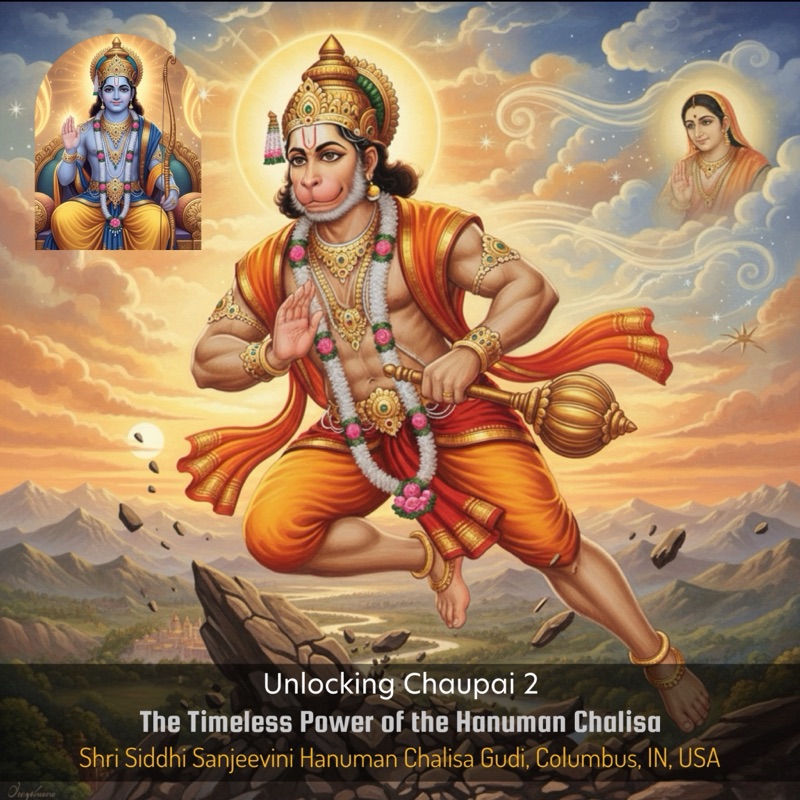
Being the 11th Rudra incarnation of Lord Shiva and the son of Vāyu (the Wind God), Hanuman was born with extraordinary power, speed, and divine energy. His very being was charged with prāṇa-śakti — the vital life-force that moves the universe.
Even as a child, Hanuman’s strength was limitless. When he leapt toward the sun thinking it a fruit, Indra struck him with the Vajrāyudha, knocking him unconscious. Pleased by Vāyu’s devotion, the gods revived Hanuman and blessed him with invincible strength and divine powers.
Later, under the guidance of Sūrya Deva (the Sun God), Hanuman studied all the branches of knowledge — scriptures, grammar, logic, yoga, philosophy, and even subtle sciences. Thus he possessed the perfect union of power (bala) and wisdom (jñāna) — a rare divine combination.
Yet, despite these limitless gifts, Hanuman never identified himself as powerful, learned, or divine. When asked “Who are you?” he would simply bow his head and reply with utmost humility:
“I am the servant of Rama.”
In that one statement lies the essence of his being — complete surrender of ego. Hanuman knew that all his abilities were meaningful only when used in the service of his Lord. His strength was not for self-display but for seva (service).
Thus, “राम दूत” doesn’t just mean messenger — it signifies one whose very existence is dedicated to carrying out Rama’s will, who sees himself not as the doer, but as the instrument of the Divine.
He made Rama-bhakti his only identity, his only purpose, his only pride.
To be “Rāma Dūta” was not his title — it was his truth.
What divine emotion should one invoke?:
Imagine and glorify Hanuman’s unwavering devotion and selfless service to Rama, while also admiring his immense strength. Though endowed with boundless power, his ego remains completely surrendered — every ounce of his might dedicated solely to serving Lord Rama.
अंजनि पुत्र पवनसुत नामा - Pavanasuta Añjani Putra Nāmā
Known by the names: Son of Anjani, Son of the Wind (Vāyu Putra)
Anjani means pure perception — a mind like a spotless mirror. Hanuman, as her son, embodies this purity. His mind, free from ego and distortion, perfectly reflects the image of Rama. Thus, Anjani Putra signifies one “born of inner purity,” the mind made clear enough to hold the Divine within.
Vāyu represents prāṇa, the vital force that sustains all life. As Pavanasuta, Hanuman personifies this awakened life-energy — powerful yet guided by devotion, not desire. In yogic vision, he is the prāṇa that carries Rama’s consciousness through the entire being, energizing body, mind, and soul with divine awareness.
What divine emotion should one invoke?:
While invoking Hanuman’s divine parents — Mother Anjani and Father Vayu — take a moment to remember and honor your own parents, through whom life and grace have flowed to you.
- Type of Verse: Praise of Hanuman
- Guna: Ramaduta (Obideience), Atulita Bala (immense Strength)
These qualities are beautifully expressed in the prabhāvali of the Shree Siddhi Sanjeevini Hanuman idol — Nandi embodies Vinaya (humility and obedience), while Varaha, who upholds the earth, signifies Hanuman’s impeccable strength. Varaha also appears as one of the faces of Panchamukhi Hanuman on the prabhāvali, further symbolizing this divine power in service of dharma.
Jai Shree Ram! Jai Hanumaan!!
Compiled by - bharath balemane
Shri Siddhi Sanjeevini Hanuman Chalisa Gudi, Columbus, IN, USA


Comments
Post a Comment