Unlocking Chaupai 3
~ Sat, Oct 18, 2025
महावीर विक्रम बजरंगी।
कुमति निवार सुमति के संगी॥
Transliteration:
Mahāvīra Vikrama Bajarangī,
Kumati Nivāra Sumati ke Sangī.
Meaning:
"O valiant and courageous one, whose body is as strong as the thunderbolt,
You remove evil or distorted thinking and are ever the companion of pure and noble thoughts.”
Word-to-Word Meaning:
- महावीर (Mahāvīra) means the great hero, one endowed with supreme courage and valor.
- विक्रम (Vikrama) signifies strength, prowess, and gallantry — one who performs mighty and noble deeds.
- बजरंगी (Bajarangī) refers to the one whose body is as strong as vajra, the thunderbolt weapon of Indra — a name that highlights Hanuman’s indestructible power.
- कुमति (Kumati) stands for wrong understanding, delusion, ignorance, or negative thinking.
- निवार (Nivāra) means remover, dispeller, or destroyer.
- सुमति (Sumati) denotes right understanding, wisdom, good sense, and noble intellect.
- के संगी (ke Sangī) means the companion, associate, or friend of.
1. महावीर विक्रम बजरंगी - Mahāvīra Vikrama Bajarangī
Hanuman is called Mahāvīra—the embodiment of supreme heroism, not just physical but spiritual valor.
His Vikrama (mighty deeds) are countless — leaping across the ocean, defeating demons, bringing Sanjivani, and above all, conquering his own ego.
- Mahāvīra represents the conquest of fear.
- Vikrama represents courage in action.
- Bajarangī (from Vajra-Aṅga — diamond-bodied) symbolizes invincible strength — both physical and spiritual.
His strength is not born of pride but of devotion and purity. Just as vajra is indestructible, Hanuman’s resolve and faith are unshakable.
What divine emotion should one invoke?:
Invoke the bhāva of “Āveśa” — divine infusion of strength, courage, and fearlessness. It’s the feeling that Hanuman’s heroic energy (Mahāvīra-shakti) is entering your being — not as something external, but as your own awakened inner power.
2. कुमति निवार सुमति के संगी - Kumati Nivāra Sumati ke Sangī
This half reveals Hanuman’s psychological and spiritual role for the devotee.
- Hanuman removes ignorance, ego-driven thinking, confusion — Kumati - the inner demons and cultivates Sumati, pure intellect, discrimination (viveka), selflessness — divine wisdom.
He represents the mind purified by devotion — Manas that has become Hanuman.
When the heart turns toward Rama (Truth, Dharma), Hanuman awakens within us, driving away confusion and delusion (Kumati), replacing it with clarity, faith, and discernment (Sumati).
What divine emotion should one invoke?:
Invoke the bhāva of “Shuddhi” — inner purification and grace.
Feel Hanuman lovingly cleansing your mind and heart, sweeping away dark or negative thoughts (kumati), and filling you with divine wisdom, clarity, and noble intention (sumati).
- Type of Verse: Praise of Hanuman, The benefit (Phala)
- Guna: Mahaveera (Valour), Vikrama (Courage)
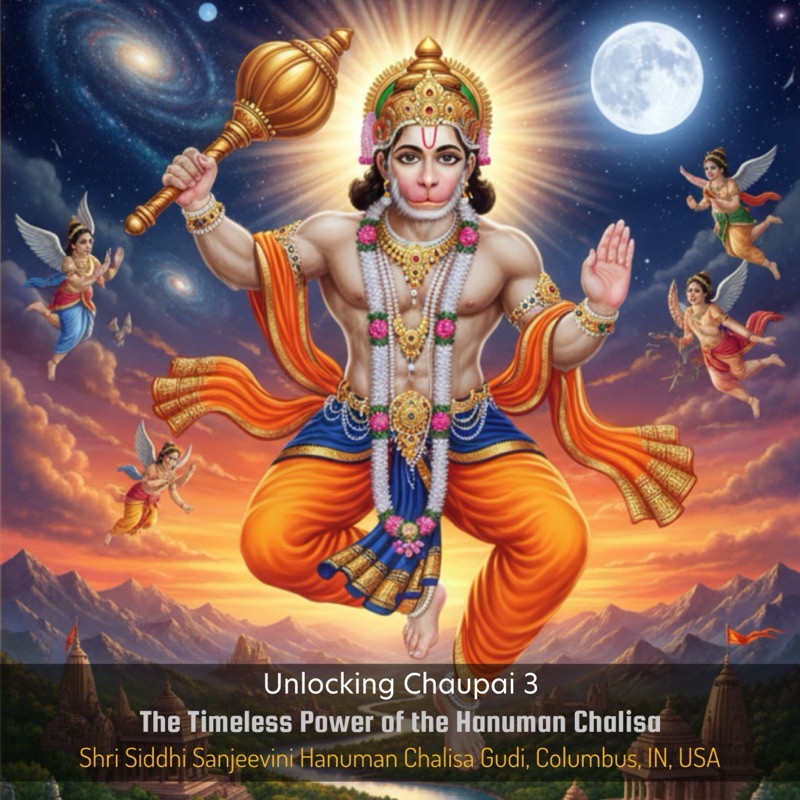
These qualities are beautifully reflected in the prabhāvali of the Shree Siddhi Sanjeevini Hanuman idol — the mace is positioned in such a way that Hanuman can effortlessly reach it with his right hand. With this mace, He has accomplished great feats, symbolizing His immense strength and valor.
Jai Shree Ram! Jai Hanumaan!!
Compiled by - bharath balemane
Shri Siddhi Sanjeevini Hanuman Chalisa Gudi, Columbus, IN, USA
Further Reading!
What is the story behind Hanuman’s name Bajrangī?
Vajra (वज्र) → thunderbolt, diamond — the weapon of Indra, king of the gods. It symbolizes indestructible strength and divine power.
Aṅga (अङ्ग) → limb or body.
As a child, Hanuman once mistook the rising sun for a ripe fruit and leapt to seize it. Indra, alarmed, struck the child with his vajra (thunderbolt) to stop him.
The blow hit Hanuman on the chin (hanu), knocking him down unconscious.
But instead of perishing, the child was miraculously revived by the gods:
- Vayu Deva, his father, withdrew air from the universe in grief, suffocating all beings.
- To appease him, Indra repented and blessed Hanuman saying:
“May your body be as strong and invincible as my vajra.”
Thus, his limbs (aṅga) became as hard as diamond (vajra). From then on, he was called Vajra-Aṅgī → Bajarangī.


Comments
Post a Comment