Unlocking Doha 2
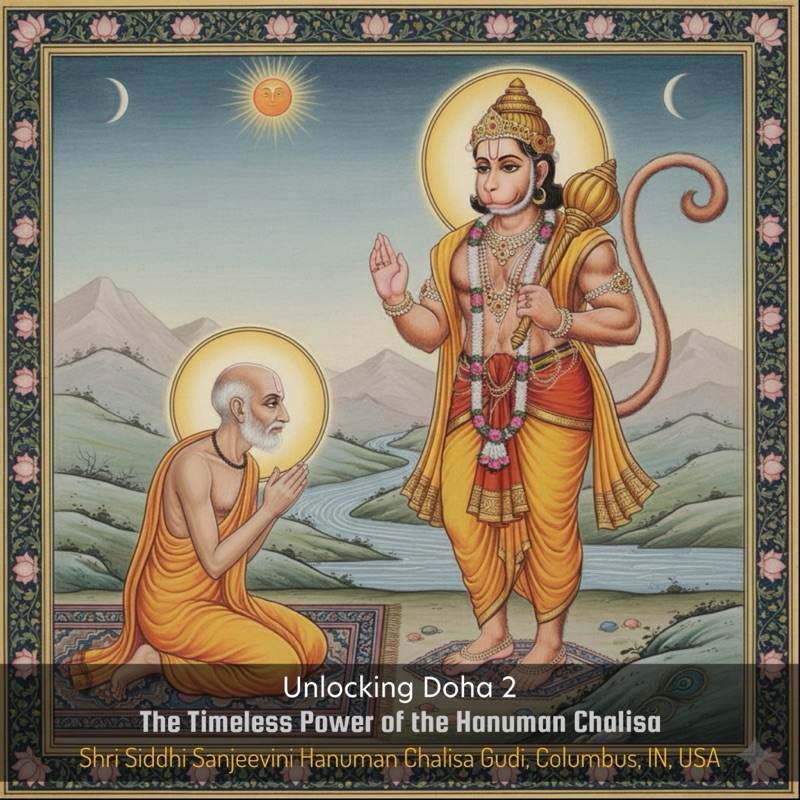
~ Tue, Oct 07, 2025
Doha 2
बुद्धिहीन तनु जानिके सुमिरौं पवनकुमार।
बल बुद्धि विद्या देहु मोहि हरहु कलेस विकार॥
buddhihīna tanu jānike sumirauṃ pavana-kumāra |
bala buddhi vidyā dehu mohi harahu kalesa vikāra ||
Knowing that I am ignorant, I remember You, O Son of the Wind (Hanuman).
Please grant me strength (bala), wisdom (buddhi), and knowledge (vidyā), and remove my afflictions (kalesa) and impurities (vikāra).
- बुद्धिहीन (buddhi-hīna) — without wisdom, lacking understanding
- तनु (tanu) — this body, this limited self.
- जानिके (jānike) — knowing, realizing, acknowledging.
- सुमिरौं (sumirauṃ) — I remember, I meditate upon, I invoke.
- पवनकुमार (pavan-kumāra) — O son of the Wind, Hanuman.बल (bala) — strength, physical and spiritual power.
- बुद्धि (buddhi) — intellect, right understanding, clarity of mind.
- विद्या (vidyā) — knowledge, sacred wisdom, learning.
- देहु (dehu) — give, bestow, grant.
- मोहि (mohi) — to me, upon me.
- हरहु (harahu) — remove, take away.
- कलेस (kalesa) — suffering, pain, distress.
- विकार (vikāra) — impurities, defects, inner distortions such as desire, anger, pride, greed, delusion.
1. बुद्धिहीन तनु जानिके सुमिरौं पवनकुमार (buddhihīna tanu jānike, sumirauṃ pavana-kumāra)
— O Hanuman, remembering that my body (and mind) is devoid of wisdom
- Buddhihīna: This limited being, devoid of higher understanding. The devotee begins with complete humility and self-awareness.
- Tanu(body): implies identification with the physical and egoic self — the state of limited consciousness.
- Sumirauṃ: to remember or meditate upon — a sacred act of inner invocation.
- Pavana Kumara: Son of Wind God (Vāyu), meaning the vital prāṇa within us
Hanuman represents Prāṇa Shakti — the living force that animates the mind and body. Just as wind is invisible yet powerful,
Hanuman’s energy works unseen yet moves everything. Calling upon “Pavan Kumar” means awakening the inner life-force and directing it toward higher wisdom.
What divine emotion should one invoke?:
“With humility, I acknowledge my own limitations and lack of true wisdom"
By acknowledging one’s limitations, the ego softens, creating space for divine intelligence to flow. True wisdom does not arise from claiming knowledge, but from admitting ignorance — a humility that awakens Hanuman, the embodiment of pure consciousness, within.
2. "बल बुद्धि विद्या देहु मोहि हरहु कलेस विकार" — bala buddhi vidyā dehu mohi harahu kalesa vikāra
Grant me strength, wisdom, and knowledge, remove my afflictions and impurities
- Bala: Physical and moral strength; inner resilience and the vital energy that keeps one steadfast on the path of dharma, overcoming laziness and inertia (tamas).
- Buddhi: Intellect and discernment; the divine faculty of viveka that distinguishes truth from illusion — the inner guidance of Guru Hanuman.
- Vidyā: Knowledge and learning; spiritual wisdom that leads to awareness of the Self — the highest knowledge beyond books and intellect.
Together, these three are the trinity of empowerment required for spiritual success.
Without bala, we falter.
Without buddhi, we misdirect energy.
Without vidyā, we remain bound by ignorance.
What divine emotion should one invoke?:
Invoke Hanuman’s grace to harmonize strength (energy), wisdom (intellect), and knowledge.
- Kalesa: From the Sanskrit root √kliś (क्लिश्) meaning to torment or cause pain, Kleśa literally means affliction or mental suffering.
- In Patañjali’s Yoga Sūtras (2.3), the five kleśas are described as the root causes of human misery — the impurities that bind the soul to ignorance and rebirth:
- अविद्यास्मितारागद्वेषाभिनिवेशाः क्लेशाः॥
- Avidyā, Asmitā, Rāga, Dveṣa, Abhiniveśaḥ — these are the Kleśas.
- Avidyā — ignorance of the true Self.
- Asmitā — egoism; identification with body and mind.
- Rāga — attachment to pleasure.
- Dveṣa — aversion to pain.
- Abhiniveśa — clinging to life; fear of death or loss.
- Vikāra: the six enemies (ṣaḍ-ripu).(Vikāra) comes from the root √kṛ with the prefix vi–, meaning distortion or alteration from one’s original pure state.
- Scripturally (Bhagavad Gītā 2.62–63), vikāras are the emotional and moral distortions arising from desire and attachment — the manifestations of kleśa.
- Common vikāras include:
- Kāma (काम) — Lust or uncontrolled desire
- Krodha (क्रोध) — Anger
- Lobha (लोभ) — Greed
- Moha (मोह) — Attachment, delusion, or infatuation
- Mada / Ahankāra (मद / अहंकार) — Pride or ego
- Mātsarya / Irṣyā (मात्सर्य / ईर्ष्या) — Jealousy or envy
These disturb the mind and obscure its natural peace, purity, and consciousness.
When Tulsidas prays “हरहु कलेस विकार”, he is asking Hanuman to remove:
- Kleśa — the root causes of suffering (ignorance, ego, fear, etc.)
- Vikāra — the visible distortions they produce (lust, anger, greed, etc.)
What divine emotion should one invoke?:
Hanuman, please free my mind from suffering and help me overcome the six internal foes.
- Type of Verse: Invocation
- Guna: None


Comments
Post a Comment